
Apple_Iphone_duo

 Apple iPhone Duo Apple has spent nearly two decades defining the iPhone as a single, fixed slab of glass and metal — and with the Duo, that definition finally changes. It's the biggest structural shift to the iPhone since the original launched in 2007, and it arrives at a moment when foldable phones from Samsung and Huawei have already had years to mature. We've detailed its features and use cases below. The Apple iPhone Duo , announced in September 2026 alongside the iPhone 18 Pro and Pro Max, is Apple's first foldable iPhone , opening book-style from a compact outer display into the largest screen Apple has ever put in an iPhone. The Duo is designed for early adopters and power multitaskers who want tablet-like screen real estate that folds away into a normal pocketable phone. 🔍 iPhone Duo: Detailed Features 📱 Design & Build Book-style foldable, titanium frame Machined and polished titanium construction, with a hinge designed for a fluid, continuous feel when op...

Elinchrom Remote Trigger

Best Remote Trigger Elinchrom

The remote triggers are always helpful to sync the speedlights and set up you're lighting as per requirements. Elinchrom offers various of triggers for all kinds of photographers. 

Skyport Transmitter Pro

Highly configured and best in class transmitter from Elinchrom. Available in Amazon.in and Amazon.com.

B016EWNUO0


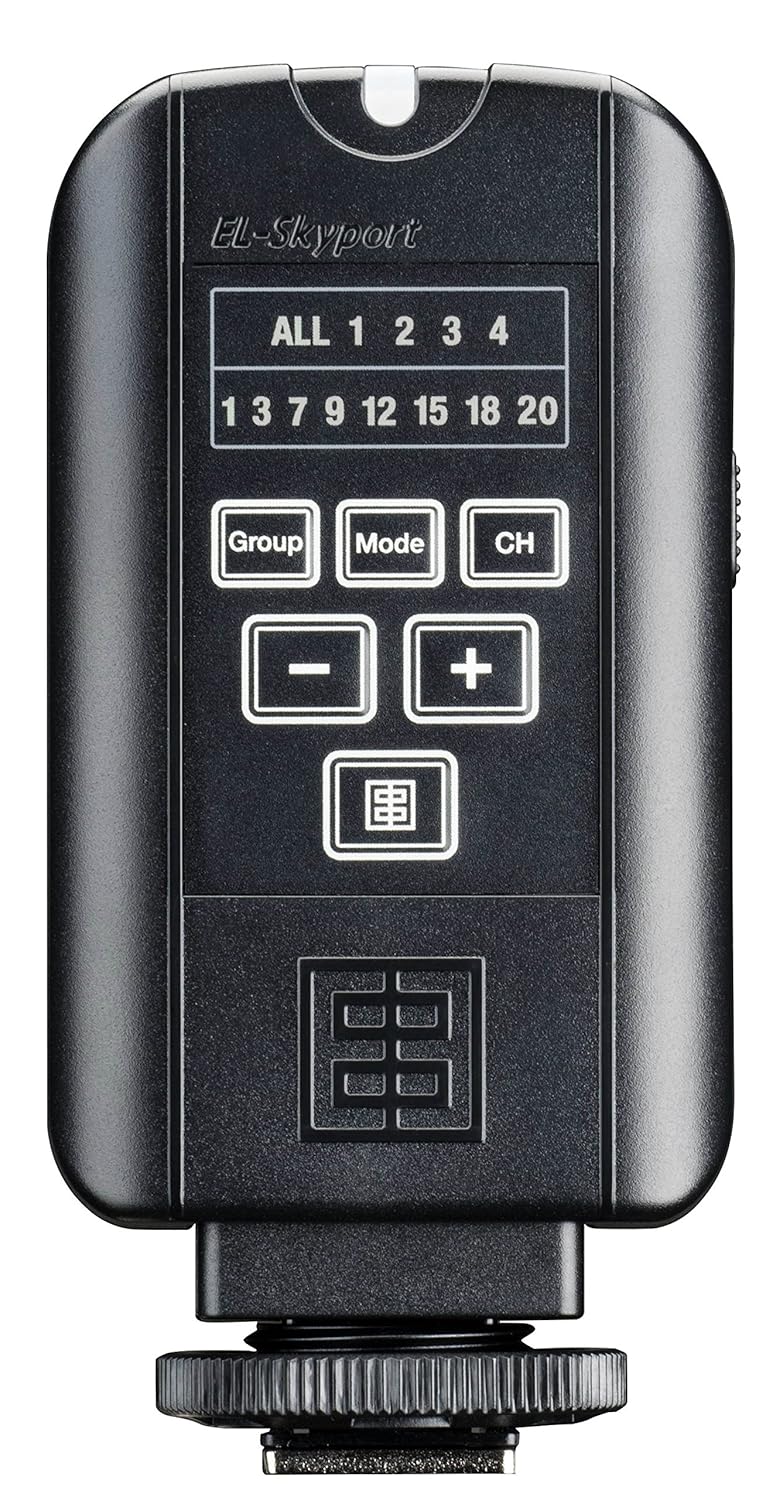
Elinchrom EL Skyport Transmitter Plus

Trigger reliably and adjust flash power up to 200 m (656 feet) away. Optimize reception by rotating the transmitter.
16 different channels (8 in normal mode and 8 in speed mode) are available – 6 for legacy units and 10 for newer units such as ELC Pro HD and ELB 400
The flash power per group can be quickly increased or decreased. Runs on AA batteries, available everywhere.
Simple to use. All functionalities can be easily adjusted.
Durable with robust mechanics thanks to its Swiss design
Please check out best deal in Amazon.in and Amazon.com
Comments

Popular posts from this blog

Compare Sony 200-600 vs Nikon 180-600 vs Canon 100-500

Compare Sony FE 200-600mm f/5.6-6.3 G OSS ,  Nikon Z 180-600mm f/5.6-6.3 VR , and  Canon RF 100-500mm f/4.5-7.1L IS USM Here's a detailed comparison of the Sony FE 200-600mm f/5.6-6.3 G OSS , Nikon Z 180-600mm f/5.6-6.3 VR , and Canon RF 100-500mm f/4.5-7.1L IS USM lenses. These lenses cater to wildlife, sports, and outdoor photography, each offering unique strengths. 1. Focal Length Lens Focal Length (Full-Frame) Effective Range on APS-C/DX Bodies Sony 200-600mm 200-600mm 300-900mm Nikon 180-600mm 180-600mm 270-900mm Canon 100-500mm 100-500mm 160-800mm Nikon starts at 180mm, offering slightly more reach than Canon at the wide end. Sony and Nikon extend to 600mm, while Canon maxes out at 500mm. 2. Aperture Range Lens           Aperture (Wide to Telephoto) Sony 200-600mm                f/5.6-6.3 Nikon 180-600mm                f/5.6-6.3 Canon 100-500mm ...

iPhone 15 Pro Camera

iPhone 15 Pro Camera features with details T he iPhone 15 Pro introduces a suite of advanced camera features, enhancing both photography and videography experiences. Here's a detailed overview of its camera capabilities:​ 📸 Rear Camera System The iPhone 15 Pro is equipped with a versatile triple-lens rear camera setup: ​ Main (Wide) Camera : Resolution : 48 MP Aperture : f/1.78 Focal Length : 24mm equivalent Sensor Size : 1/1.28" Pixel Size : 1.22µm Features : Dual Pixel Phase Detection Autofocus (PDAF), Sensor-Shift Optical Image Stabilization (OIS) Telephoto Camera : Resolution : 12 MP Aperture : f/2.8 Focal Length : 77mm equivalent Pixel Size : 1.0µm Features : PDAF, OIS, 3x Optical Zoom ​ Ultra-Wide Camera : Resolution : 12 MP Aperture : f/2.2 Focal Length : 13mm equivalent Field of View : 120° Sensor Size : 1/2.55" Pixel Size : 1.4µm Features : Dual Pixel PDAF ​ LiDAR Scanner : Enhances dep...

Comparison: Nikon Z6 III vs. Nikon Z8

Comparison: Nikon Z6 III vs. Nikon Z8 We are going to compare two of Nikon's popular cameras. The Nikon Z6 III and Z8 are both high-performance cameras in Nikon’s mirrorless lineup, but they cater to different user needs. The Z6 III is more versatile for enthusiasts, while the Z8 is a flagship-level camera targeting professionals. 1. Key Specifications Feature Nikon Z6 III Nikon Z8 Sensor 24.5 MP Full-Frame BSI CMOS 45.7 MP Full-Frame Stacked CMOS Processor EXPEED 7 EXPEED 7 ISO Range 100–51,200 (Expandable to 50–204,800) 64–25,600 (Expandable to 32–102,400) Autofocus 273 AF Points, AI Detection 493 AF Points, AI Detection Continuous Shooting 14 fps 20 fps (RAW), 30 fps (JPEG) Video 4K/60p (Full Sensor Readout) 8K/60p, 4K/120p IBIS (Stabilization) 5-axis IBIS 5-axis IBIS EVF 3.69M-dot OLED 3.69M-dot OLED Display 3.2” Tilting Touchscreen 3.2” Tilting Touchscreen Battery Life Approx. 410 shots (CIPA) Approx. 330 shots (CIPA) Weight ~705 g (Body Only) ~910 g (Body Only) 2. Build and D...